When most people think of acupuncture, they picture fine needles, maybe a tongue check, or the practitioner quietly feeling the pulse at the wrist. These are familiar tools in Chinese Medicine, offering valuable clues about what is happening inside the body.
But there is another layer of diagnosis called channel palpation. It is a central part of the style I practise, known as Applied Channel Theory, and it has deeply shaped how I understand health, pain, and healing.
Listening Through Touch
Like many acupuncturists, I was trained in Traditional Chinese Medicine (TCM) and Five Element theory. Alongside this, I practise Applied Channel Theory and continue my studies through monthly mentorship with a Beijing-based doctor trained by Dr. Wang Ju-Yi, a Chinese Medicine physician later declared a Grandmaster, the highest professional title in China.
Most people who have seen an acupuncturist are familiar with diagnostic tools like tongue and pulse reading. These are known as microsystems, meaning they reflect the internal state of the body in small, specific areas.
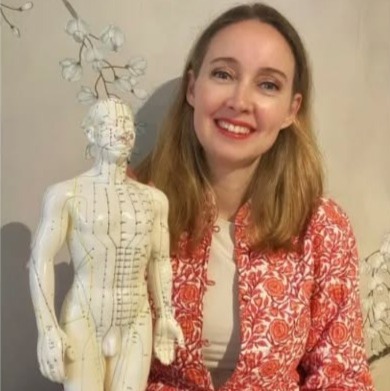
Applied Channel Theory uses these methods too, but it adds something powerful: palpating the channels themselves. This means gently feeling along the acupuncture pathways on the body, the energy lines you may have seen on charts or acupuncture dolls (see image above  ).
).
By touching the channels, we can gather precise, real-time information about which pathways are under strain or not functioning well. In my own clinical experience, this approach often leads to clearer diagnoses and more effective treatments, sometimes faster than more traditional acupuncture methods.
What Are Acupuncture Channels, really?
During my studies, I began asking a question many students quietly wonder about.
What exactly are acupuncture channels?
In acupuncture school, channels are often described as vertical pathways through which Qi (energy) and Blood flow. When these pathways become blocked, pain or illness can arise. While this explanation works theoretically, it can feel vague or even mystical.
While working on my dissertation, I wanted to better understand what these channels might be in physical terms.
Where Ancient Medicine Meets Modern Science
Applied Channel Theory, developed by Dr. Wang Ju-Yi, offers a bridge between classical Chinese medicine and modern anatomy.
Rather than viewing channels as abstract energy lines, this approach suggests they correspond to the natural spaces (or gaps) between flesh, muscles, sinews, and bones. Channels can be understood as pathways within this connective tissue system.
Modern research is beginning to support this view. Studies have found significant overlap between acupuncture channels and connective tissue planes and fascia—a thin, strong, and flexible web that surrounds and connects every structure in the body. Fascia is increasingly understood as a body-wide communication network, capable of transmitting tension, pressure, and movement. Notably, one well-known study found that over 80 percent of acupuncture points examined were located at intersections of connective tissue layers (Langevin and Yandow, 2002).
Other research suggests these pathways or acupuncture channels may conduct electrical signals differently from surrounding areas, offering one explanation for how acupuncture can influence pain, movement, and internal function (Ahn et al, 2010).
Scientists have also observed dyes or tracers injected into acupuncture points migrating along pathways that closely resemble traditional acupuncture channels. Importantly, this dye migration appears to follow interstitial fluid pathways within loose connective tissue (Zhang et al, 2008).
While the research is still evolving, it offers a compelling way to understand how ancient observations and modern science may be describing the same system through different languages.
Channels and Organs as Inseparable
In Applied Channel Theory, channels and organs are inseparable, showing two sides of the same imbalance. Channels aren’t only tissue spaces; they include everything within them, from blood vessels to nerves and fluids, and thus influence how the body functions. They help regulate movement, digestion, immunity, hormones, and more. That is why palpation matters. By feeling tender channels or those with for example nodules, practitioners can pinpoint imbalances directly without guesswork.
How We Work at Innr Wellness
At Innr Wellness in Winchester, this understanding guides every treatment.
We combine channel palpation with classical Chinese Medicine, and modern clinical insight to create care that is highly personalised and responsive. Rather than following a standard formula, we let your body and its channels guide the treatment.
What may once have seemed mysterious becomes practical and grounded. The channels are not abstract ‘energy’ lines but living pathways that help us listen more closely to the body and support its natural ability to heal and return to inner balance (or homeostasis).